What Is A Palletizer? Comprehensive Analysis Of Working Principles, Types, And Enterprise Applications
For enterprises in food and beverage, cement and building materials, industrial product manufacturing, etc., palletizing is the last mile at the end of production—it needs to quickly handle hundreds or thousands of products, ensure neat stacking without collapse, and avoid efficiency decline and safety hazards caused by long-term manual repetitive labor. The emergence of palletizers is precisely to solve this core pain point: it is a professional equipment in the field of industrial automation specifically used for accurately and efficiently stacking products onto pallets, and has become a standard tool for modern production lines.
I. Core Working Principle of Palletizers: Disassembling the Grasping-Handling-Stacking Logic Chain
The workflow of a
palletizer revolves around precise positioning + stable handling, essentially replacing manual labor with machinery to complete the repetitive actions of material taking-transferring-placing. The specific steps are as follows:
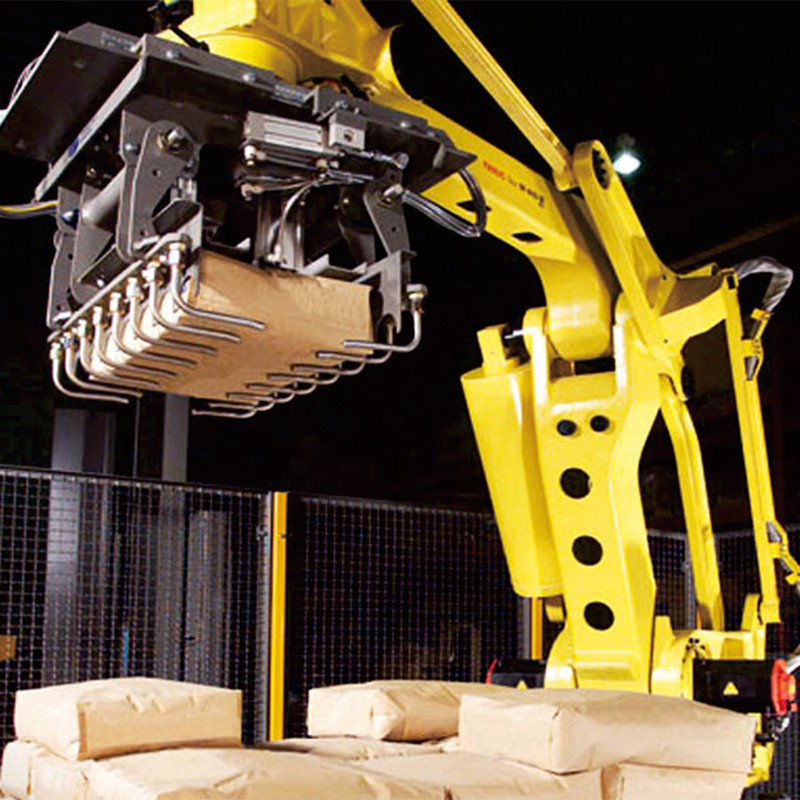
1. Material Taking: The gripper (or suction cup, clamp) mounted on the robotic arm moves to the product source (such as the end of the packaging line, storage table), and adjusts the grabbing method according to the product type (e.g., grippers for cartons, magnetic adsorption for metal cans);
2. Positioning Adjustment: The robotic arm can translate along the XYZ axes (Cartesian coordinates) and rotate around the vertical axis to ensure the gripper is perfectly aligned with the product and pallet;
3. Stacking: When the gripper reaches the product height, it clamps (or adsorbs) the product, then precisely moves to the top of the pallet, and places it according to a preset stacking pattern (such as well shape, layered style), completing one cycle.
The entire process requires no manual intervention, with errors controlled within a few millimeters, perfectly solving the problems of manual palletizing being slow, messy, and tiring.
II. 4 Common Types of Palletizers: Choosing the Right Equipment Based on Products
Product characteristics vary greatly across industries (e.g., cement bags weigh 50kg, bottled water is collision-sensitive, metal parts are scratch-prone), so palletizers have also evolved into various types to adapt to different scenarios:
1. Cartesian Palletizer: Handling Expert for Heavy Products
It achieves precise positioning relying on the linear movement of XYZ axes, suitable for heavy, uniformly规格d products (such as cement bags, fertilizer bags, large cartons). Its advantages are strong load capacity (up to hundreds of kilograms) and high stability, making it the first choice for cement and building materials enterprises.
2. Layer Palletizer: Efficient Processor for Whole-Layer Products
Focused on batch handling of whole-layer products, such as bottled water and canned beverages in food and beverage factories—it first arranges products into a complete layer (e.g., 10 bottles × 8 bottles), then moves the entire layer to the pallet for stacking. This type of palletizer is extremely fast (up to 30-50 layers per minute), perfectly matching the rhythm of high-speed production lines.
3. Magnetic Gripper Palletizer: Gentle Handler for Fragile Products
It uses magnetic adsorption instead of mechanical grippers, suitable for metal products (such as steel, metal cans, hardware parts). Its advantage is that it does not damage the product surface, avoiding scratches and deformation during manual handling, and is commonly used in auto parts and household appliance manufacturing industries.
4. Palletizing Robot: Flexible Player for Small-Batch Customization
Different from the fixed trajectory of traditional palletizers, palletizing robots have multi-joint flexible movement capabilities and can be programmed to adapt to products of different shapes and specifications (such as special-shaped part boxes, small-batch custom packaging). Its application scenarios are wider, especially suitable for multi-variety, small-batch production modes such as e-commerce warehousing and pharmaceutical packaging.
III. The Value of Palletizers for Enterprises: Comprehensive Improvement from Efficiency to Cost
For enterprises, the value of palletizers goes far beyond replacing manual labor—it can bring tangible benefits in four dimensions: efficiency, cost, safety, and space:
1. Improve Efficiency: 3-5 Times Faster than Manual Labor
Manual palletizing can handle at most 10-15 products per minute, while palletizers can reach 30-60 products/minute (or even higher), especially suitable for order surge scenarios during peak production periods, avoiding production line stagnation due to slow palletizing.
2. Reduce Costs: Decrease Labor and Rework Expenses
The monthly salary of a worker is about 4,000-6,000 yuan, while the annual operating cost of a palletizer is only 1/3 of that of manual labor; at the same time, the error rate of mechanical stacking is almost zero, avoiding hidden costs such as stack collapse rework and product damage caused by human errors.
3. Ensure Safety: Avoid Work-Related Injury Risks
For heavy products such as cement and fertilizer (25-50kg per bag), manual handling is prone to back pain and joint damage; palletizers can take on 100% of the heavy work, reducing the risk of work-related injury compensation for enterprises.
4. Save Space: Improve Warehouse Utilization
Palletizers have higher stacking precision and can stack pallets more neatly and higher (some can stack up to 2-3 meters), increasing storage capacity by 20%-30% compared to manual stacking, indirectly reducing warehouse rent costs.
IV. The Future of Palletizers: From Automation to Intelligence
With the development of Industry 4.0 technology, palletizers are evolving towards more flexible and intelligent directions: for example, equipped with visual recognition systems, they can automatically identify products of different specifications (such as special-shaped cartons, mixed packaging) without manual parameter adjustment; or linked with ERP systems to switch stacking modes in real-time according to order requirements (e.g., compact stacking for small-batch orders, layered stacking for large-batch orders).
In the future, the application scenarios of palletizers will further expand—from traditional food and cement industries to medical, e-commerce warehousing, new energy (such as battery module stacking) and other细分领域, becoming a core tool for enterprises to achieve cost reduction and efficiency improvement.
For enterprises, the key to choosing a palletizer is not buying the most expensive one, but choosing the most suitable one: matching the corresponding type according to product weight, specifications, and industry needs (e.g., layer palletizers for food and beverage, magnetic gripper palletizers for metal parts) to truly exert its value. With the popularization of automation technology, palletizers are no longer exclusive to large enterprises; small and medium-sized factories can also upgrade production lines through low-cost models—after all, replacing repetitive labor with machinery has always been the optimal solution for enterprises to reduce costs.