A
single-scale packing machine weighs one bag at a time in one weighing bucket, then releases that weighed dose into the bag. It is the simplest architecture in dry bulk filling, and for 10–50 kg bags it is still the most common one, because a single load cell and a single discharge path remove most of the variables that make multi-head weighers expensive to own.
The published numbers on this class of machine — up to 600 bags per hour on cylinder control, up to 900 on servo control, ±0.2% accuracy on 10–50 kg bags — are achievable, but only when the machine, the product and the line around it are matched. This article looks at where those numbers come from and what breaks them.
What "Single Scale" Means in Practice
A single-scale net weight filler works in four steps: the empty bag is clamped under the discharge spout, the weighing bucket fills through a fast feed and a slow dribble feed, the load cell settles and the weight is confirmed, then the gate opens and the product drops into the bag.
Because the dose is weighed before it enters the bag, the bag weight does not include the bag itself, and there is no need to tare per bag. That is the main reason the architecture suits products with a stable bulk density and a bag weight that must be legally defensible.
Where it beats a dual-scale machine
A dual-scale machine weighs two doses in parallel and alternates discharge, which raises output but doubles the weighing hardware and the calibration work. A
single-scale machine wins when the bag is heavy, the product is dusty or aggressive, or the annual volume does not justify the extra scale. It also wins on floor space: one weighing column, one discharge point, one bag clamp.
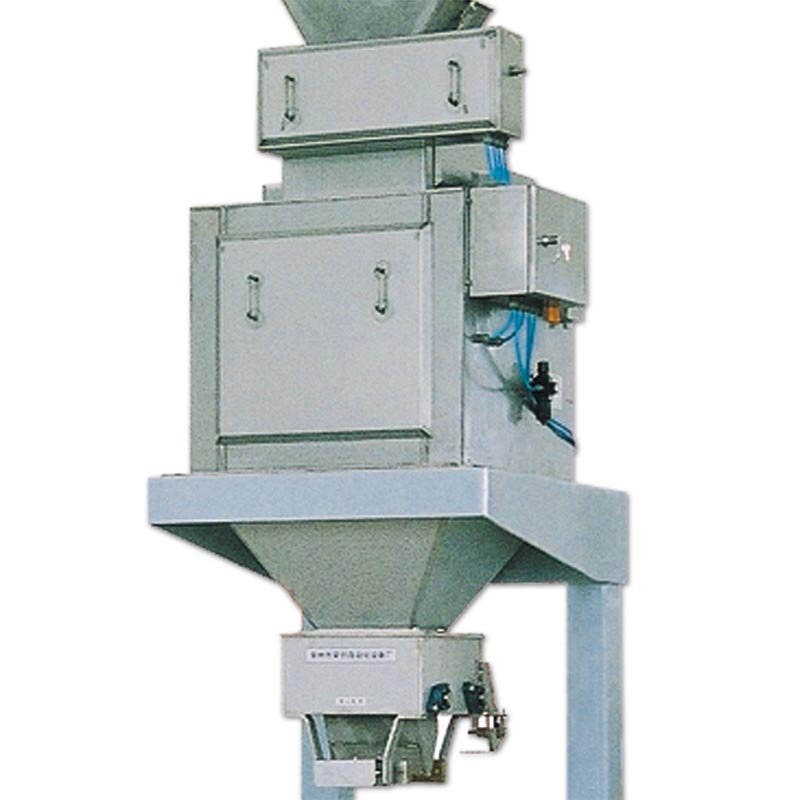
Small Fully Automatic Weigh Filler Packing Machine
Where it loses
Fine powders that fluidize, products with a wide particle-size spread, and blends that segregate in a drop will all cost accuracy on a single-scale machine. In those cases the answer is usually a different feeding structure rather than a different scale.
Where ±0.2% Comes From
On a 25 kg bag, ±0.2% is ±50 g. That is not a single number produced by the load cell; it is the sum of five error sources, and each one has to be held in check.
|
Error source |
Typical contribution |
How it is controlled |
|
Load cell resolution and drift |
5–10 g |
Calibrated cell, temperature compensation, routine check weights |
|
Fast-feed overshoot |
20–30 g |
Fast/slow switch point set per product and per bag size |
|
Material in flight after the gate closes |
10–20 g |
Dribble feed, gate closing speed, discharge chute design |
|
Product density variation |
10–30 g |
Volumetric pre-feed trimmed by weight feedback |
|
Bag and clamp interaction |
5–15 g |
Weighing bucket isolated from the bag clamp and conveyor |
The two variables that move most in production are the fast/slow switch point and the in-flight material. Both change when the product changes — a fertilizer blend that has absorbed moisture during a rainy week flows differently from the same blend in dry weather — so the machine needs a routine that re-trims the switch point at the start of each batch rather than a setting that is fixed at commissioning.
Why servo control buys more than speed
Cylinder-controlled gates are fast and cheap, and they hold up well on free-flowing granules. Servo-controlled gates close on a programmed curve, which shortens the settling time and reduces the in-flight error. That is where the jump from 600 to 900 bags per hour comes from: the machine is not filling faster, it is spending less time waiting for the weight to settle.
The Output Number and What Eats It
At 900 bags per hour, the machine has 4 seconds per bag. At 600 bags per hour, 6 seconds. In both cases the weighing cycle is only part of the total, and the rest of the line decides whether the machine ever reaches its rating.
A typical cycle breaks down into bag placement or bagging, clamp, fast feed, dribble, settle, discharge, unclamp and transfer. On a semi-automatic line where an operator places the bag, the operator sets the pace, and the machine will run at 250–350 bags per hour regardless of its rating.
|
Configuration |
Rated output |
Realistic output |
What limits it |
|
Machine only, manual bag placement |
600–900 bags/h |
250–350 bags/h |
Operator pace, bag handling |
|
With conveyor and sewing machine |
600–900 bags/h |
400–550 bags/h |
Sewing head and conveyor speed |
|
With automatic bagging machine |
600–900 bags/h |
600–800 bags/h |
Bag magazine reload, bag opening reliability |
|
Full line with folding, shaping and palletizer |
600–900 bags/h |
700–900 bags/h |
Palletizer pattern and pallet exchange |
The lesson is that the packing machine is rarely the bottleneck once the line is automated. It is the bag supply, the sewing head, the check-weigher rejection rate and the pallet exchange that set the real number.
Mechanical Fit: The Numbers Nobody Quotes
Two installation dimensions decide whether the line works: the discharge height and the height available above the bag.
The discharge spout must sit high enough that a filled 50 kg bag hangs free of the conveyor before it is released, and the structure above it must clear the bag clamp and the weighing bucket. In Chuangling's single-scale layout the H dimension is supplied by the customer and cannot be less than 2100 mm, because below that the bag cannot hang clear and the clamp geometry no longer works.
The electrical control cabinet can stand beside the machine or in a control room, which matters in dusty plants where the cabinet would otherwise need a positive-pressure enclosure.
Feeding structure by product
The weighing bucket is the same; the feeding structure above it is not. Screw feeders suit fine powders and give the tightest slow-feed control. Belt feeders suit fragile granules such as pet food and blended fertilizer. Vibratory feeders suit products that must not be sheared. Gravity gates with a slide or flap suit free-flowing pellets and give the highest throughput.
Choosing the wrong feeder is the most common cause of a machine that meets its accuracy on the acceptance test and then drifts in production, because the feeder was matched to the sample rather than to the product.
Building the Line in Stages
Most buyers do not start with a full automatic line. They start with the scale, then add conveyors and a sewing machine, then a bagging machine, then a palletizer. Each step changes the machine's role, and it helps to plan the footprint for the final stage even when only the first stage is being bought.
|
Stage |
Equipment added |
Effect on labour |
Effect on output |
|
1 |
Single-scale packing machine |
One operator per bag position |
250–350 bags/h |
|
2 |
Conveyor and sewing machine |
Same operator, less walking |
400–550 bags/h |
|
3 |
Automatic bagging machine |
Operator moves to supervision |
600–800 bags/h |
|
4 |
Folding, shaping conveyor, palletizer |
One operator per line |
700–900 bags/h |
Chuangling supplies the scale, the conveyor, the sewing head and the palletizer as one line, which is why the footprint can be planned for stage four from the start. The same machine appears in food, feed, pet food, agricultural, chemical, pharmaceutical and mineral plants. What changes between those industries is the material of construction, the cleaning regime and the documentation, not the weighing principle.
Data, Traceability and the Audit Trail
Modern
single-scale machines log every dose: target weight, actual weight, timestamp, product code and operator. That log is what a customer audit asks for, and it is also the fastest way to find a drift before it becomes a rejected pallet.
Set the machine to flag any dose outside a warning band narrower than the reject band — for example, reject at ±0.2% and warn at ±0.12%. The warning count per shift is a better early indicator than the reject count, because by the time bags are being rejected the trend has been running for hours. Chuangling sets that band at commissioning against the customer's own bag weight specification, not against a factory default.
What to Specify Before Ordering
Four inputs fix the machine configuration: bag weight range, product bulk density and flow behaviour, required output in bags per hour, and the height available above the bag. Add the bag type and the sewing or sealing method, and the machine can be quoted without a site visit.
Chuangling builds the
single-scale packing machine in cylinder and servo versions and matches the feeding structure to the product rather than to a catalogue default. For buyers moving from manual bagging to an automated line, the useful first step is a layout drawing with the H dimension and the conveyor runs marked, because that drawing decides whether the palletizer can be added later without moving the scale.