A
bulk blending fertilizer packing machine does two jobs that pull in opposite directions. It has to dose three to six granular ingredients into a blend at a stated ratio, and it has to fill that blend into 25–50 kg bags at a rate the plant's logistics can absorb. At 30–80 tonnes per hour, both jobs happen in seconds, and the accuracy of the second depends on the stability of the first.
This article looks at the engineering behind that balance: how dynamic weighing holds a ratio, why hopper count matters more than hopper size, how above-ground and underground layouts change the building, and what to check at commissioning.
What a BB Line Actually Does
BB — bulk blending — means mixing granular fertilizers physically rather than chemically. Urea, diammonium phosphate, muriate of potash and filler granules are stored separately, dosed by weight in the required ratio, mixed, and bagged. The agronomic value comes from the recipe; the commercial value comes from the accuracy of the ratio and the consistency of the bag weight.
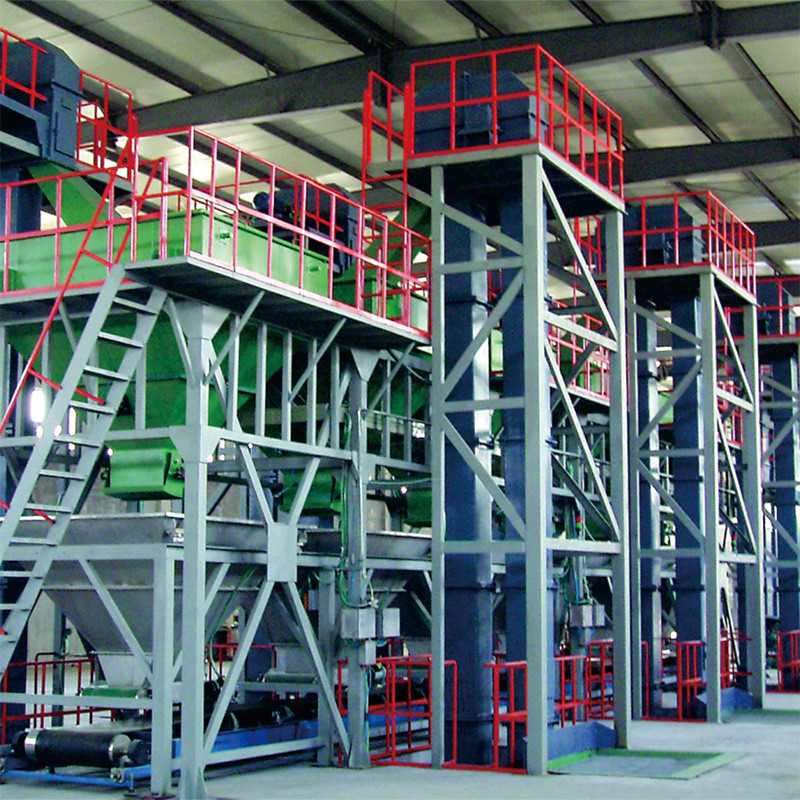
A typical line has five stages: ingredient hoppers with dosing feeders, a weighing and batching section, a mixer, a bagging scale, and a bag closing and palletizing section. The
bulk blending fertilizer packing machine sits across the last two stages, but its accuracy is decided in the first two. Chuangling builds the dosing, mixing and bagging sections as one line, which is why the hopper count and the bagging scale are sized together.
Dosing by loss of weight
The dosing principle used on these lines is loss-of-weight batching. Each hopper sits on load cells; the instrument samples the weight signal, calculates the rate of change, and controls a variable-frequency drive on the feeder so the discharge rate matches the recipe. When the target for that ingredient is reached, the feeder stops and the next ingredient starts.
Because the instrument is tracking a rate rather than waiting for a static weight, it can compensate for a hopper that is running low or a feeder whose output has drifted. That continuous correction is what allows a single line to hold ±0.5% ingredient accuracy across a 30–80 t/h range.
The Accuracy Budget
±0.5% on a 50 kg bag is ±250 g of a single ingredient. On a recipe where the smallest component is 5% of the blend, the allowed error on that component is 12.5 g per bag — a much tighter requirement than the headline number suggests.
|
Error source |
Effect on ratio |
Countermeasure |
|
Feeder rate drift as hopper empties |
0.2–0.4% |
Loss-of-weight control with rate feedback |
|
In-flight material after feeder stop |
0.1–0.3% |
Feeder run-down compensation, gate timing |
|
Load cell drift and zero error |
0.05–0.15% |
Daily zero check, monthly calibration |
|
Segregation in the mixer or chute |
0.3–1.0% |
Mixer dwell time, chute geometry, minimal drop height |
|
Moisture uptake and caking |
0.5–2.0% |
Covered hoppers, dehumidified air, FIFO stock rotation |
|
Bag weight variation at the packing scale |
0.2% |
Separate net-weight scale with its own check |
The last two rows are the ones that ruin a line in service. A blend that has absorbed moisture does not flow at the rate the recipe assumes, and a segregated blend delivers a bag that weighs correctly and analyses wrongly.
Why the packing scale cannot fix a bad blend
The bagging scale controls the total bag weight, not the composition. If the mixer delivered a blend that is 2% light on potash, the scale will still fill a 50 kg bag; the bag will simply be 1 kg heavy on filler. That is why the recheck scale and the lab analysis belong to the same quality loop as the batching system, and why the recipe has to be verified against the actual feeder rates rather than the nominal ones.
Hopper Count and Recipe Flexibility
A line with four hoppers can run recipes with four components. A line with six hoppers can run the same recipes and still hold one hopper for a seasonal micronutrient or a filler. Buyers usually regret buying the exact hopper count for today's product range, because the recipe that pays for the line is often the one added in year two. Chuangling sizes hoppers against the full recipe list rather than the current product, and documents the smallest component percentage the line can hold.
Multi-hopper combination control — where the control system selects which hoppers feed a given recipe — is a software function, but it needs the physical hoppers to exist. The cost of two extra hoppers at build time is far below the cost of a line rebuild later.
Above-Ground Versus Underground Layout
The single biggest layout decision on a BB line is whether the ingredient hoppers sit on a steel structure above the mixer or in a pit below grade. Both are used, and the choice changes the building, the maintenance routine and the dust control.
|
Criterion |
Above-ground line |
Underground line |
|
Civil works |
Steel structure, smaller footprint |
Excavation, retaining walls, drainage |
|
Material flow |
Gravity from hoppers to mixer |
Gravity into pit, then elevating conveyors |
|
Dust control |
Easier to enclose and extract |
Pit collects dust, needs forced ventilation |
|
Maintenance access |
Good, all equipment at floor level or on platforms |
Confined-space procedures for pit work |
|
Moisture risk |
Lower, hoppers above grade |
Higher, groundwater and condensation |
|
Relocation |
Structure can be dismantled |
Effectively permanent |
|
Typical use |
New plants, leased buildings |
Brownfield sites with height limits |
For a new plant in a region with a high water table, the above-ground line is almost always the better investment, even though the steel structure costs more than the excavation. For a brownfield site where the building height cannot take a hopper structure, the underground layout is the only option, and the design effort moves to ventilation and drainage.
Dust, Moisture and the Seasonal Reality
Fertilizer granules are abrasive, hygroscopic and dusty. Three design details decide whether the line runs clean through a humid season.
Enclosure at transfer points
Every belt-to-chute and chute-to-hopper transfer generates dust. Enclosing the transfer and extracting at the enclosure is cheaper than extracting the whole building.
Stainless or coated contact surfaces. Urea and NPK blends corrode mild steel quickly, and corrosion products contaminate the blend. Contact parts in 304 stainless, with the structure in coated carbon steel, is the usual compromise.
Moisture control in the hoppers. A covered hopper with a desiccant or dehumidified air blanket keeps the top layer of granules from caking. Caked granules bridge over the feeder and starve it, which shows up as a ratio error rather than as a mechanical fault.
Commissioning Checks That Save a Season
Before the line is handed over, run four checks in this order.
1. Static calibration on each hopper with certified test weights, recorded at three load points.
2. Dynamic calibration by running each feeder for a timed period and weighing the discharged material. This is the check that catches a feeder whose actual rate differs from its nameplate.
3. Recipe verification by batching a full recipe into a test bag and analysing the composition against the target. Do this for the smallest component, not the largest.
4. Bag weight capability study by weighing 30 consecutive bags and calculating the mean and standard deviation against the 25–50 kg specification.
A line that passes all four at commissioning will still drift; the value of the record is that it gives the plant a baseline to compare against in month six. Chuangling records all four checks in the handover file rather than in a commissioning report that stays with the installer.
Specification Inputs
Automatic Bulk Blending Fertilizer Machine Line
To size a
bulk blending fertilizer packing machine, four inputs are enough: the recipe list with the smallest component percentage, the target output in tonnes per hour, the bag weight and bag type, and the available building height. Add the local humidity range and the ingredient bulk densities, and the feeder sizing can be fixed.
Chuangling builds BB and formula fertilizer lines from the ingredient hoppers through the mixer, the packing scale and the palletizer, in above-ground and underground configurations, with HMI-based distributed control for multi-hopper recipes. Because the packing scale, the recheck scale and the palletizer come from the same design team, the bag weight and the bag pattern are specified together rather than negotiated between three suppliers.