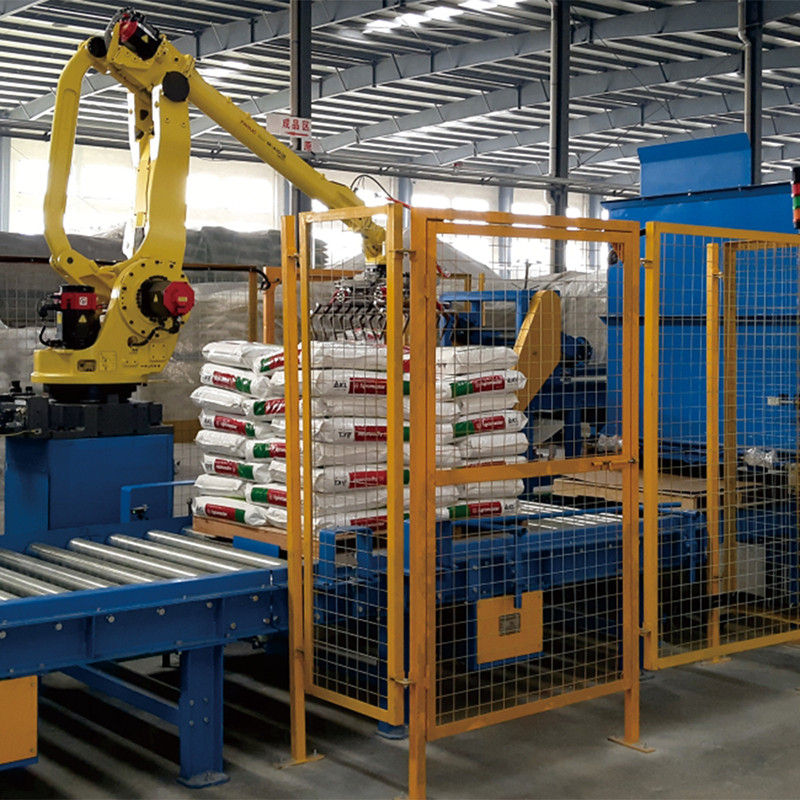
A low infeed palletizer takes bags from a conveyor that runs close to floor level, rather than from an elevated feed that drops bags onto the robot. The arrangement is popular in existing buildings, because it avoids a mezzanine or a tall incline, and it keeps the operator who seals the bags working at a comfortable height.
The trade-off is that the robot has to lift every bag from low level, which changes the cycle time, the gripper design and the safety envelope. This article covers those three, using the four-axis layout Chuangling builds for 20–50 kg bags at up to 1150 bags per hour.
What Low Infeed Changes
On a high infeed system, gravity does part of the work: bags arrive above the robot and the arm moves them down and across. On a low infeed system, every bag is picked from a belt at roughly waist height and lifted to the top of a stack that can reach 2000 mm.
That lift changes four things:
• Cycle time. The vertical travel is longer, and the return stroke is longer, so the same robot makes fewer picks per hour than it would on a high infeed.
• Gripper design. The bag has to be picked from a flat belt without the belt helping to square it. A clamp-type gripper with a bag-present sensor and a squaring action is normal.
• Safety envelope. The operator stands near the infeed, so the light curtain and the fence layout have to separate the operator from the robot's lowest reach.
• Floor space. Low infeed systems are usually longer and lower rather than shorter and taller, which suits a building with limited headroom.
The Cycle Time Budget
At 1150 bags per hour, the robot has 3.13 seconds per bag. That is the maximum palletizing speed for this class of four-axis machine, and it assumes a bag that is already squared, a short travel and a proven pattern.
|
Element |
Fast case (s) |
Typical case (s) |
Slow case (s) |
|
Bag present and squared on belt |
0.2 |
0.4 |
0.8 |
|
Gripper close and lift |
0.4 |
0.6 |
0.9 |
|
Travel to place position |
0.9 |
1.3 |
1.8 |
|
Place and release |
0.3 |
0.5 |
0.7 |
|
Return to pick |
0.8 |
1.1 |
1.6 |
|
Total |
2.6 |
3.9 |
5.8 |
The typical case lands near 900 bags per hour, not 1150. The gap is why a palletizer should be sized with a margin: if the packing line delivers 900 bags per hour and the
palletizer is rated at 1150, the line runs; if the palletizer is rated at 900 and the packing scale reaches 950, the bags back up.
Where the seconds go
The largest single element is travel, and travel is set by the layout. Placing the infeed conveyor at the base of the robot — with the pallet positions arranged around it — shortens the average travel and is the standard answer when the available floor is narrow. Where the building allows, a parallel arrangement with the pallet magazine on one side and the bag line on the other gives a longer, cleaner flow but a bigger footprint.
Layout Options and What They Cost
The layout decision is usually made by the building, not by the robot. Five arrangements cover most installations.
|
Layout |
Pallet supply |
Strength |
Constraint |
|
Vertical arrangement |
Pallet magazine plus conveyor |
Higher automation, short operator involvement |
Needs length along the line |
|
Parallel arrangement |
Pallet magazine plus conveyor |
Clean flow, easy to extend |
Wider footprint |
|
Two conveyors, one stacking line |
Pallet magazine |
Smooth stacking from a single line |
Pallet change must be quick |
|
Two conveyors, two stacking lines |
Pallet magazine |
Two products on two lines simultaneously |
Two robots or a long reach |
|
Floor-placed pallets, left and right |
Manual or forklift |
Up to three pallets without a change stop |
Operator must swap pallets |
For a plant running a single product at high volume, the two-conveyor single-line arrangement with a pallet magazine is usually the best balance. For a plant running two recipes into two bag types, the two-line arrangement pays for itself in changeover time. Chuangling draws the layout against the building rather than against a standard cell, and issues the footprint drawing before the robot model is fixed.
Pallet size and stack height
The maximum palletizing size for this class of machine is 2000 × 2000 mm, which covers a standard 1200 × 1000 pallet with room for overhang and pattern tolerance. Stack height is limited by the robot's reach and by the bag's stability, not by the pallet.
For 50 kg bags of fertilizer or feed, a stack of eight to ten layers is typical, which puts the top of the stack at 1600–2000 mm. Above that, the bottom layer starts to compress and the stack leans; the pattern has to be designed with interlocking layers rather than straight columns.
Pattern Design
A
palletizing pattern is a compromise between area utilization and stack stability. Three rules cover most cases.
Automated Robotic Palletizer
Interlock the layers. Alternate layers rotated by 90 degrees or offset by half a bag so the seams do not line up. A column-stacked pallet of 50 kg bags will lean within a few layers.
Keep the load over the pallet bearers. Bags overhanging the pallet edge by more than 30 mm deform and can catch on stretch wrapping.
Match the pattern to the bag's flat dimension. A bag that is 550 mm long and 350 mm wide gives a different pattern on a 1200 × 1000 pallet than a 600 × 400 bag, and the pattern that fits the pallet may not fit the robot's reach at the top layer.
Multiple bag types on one robot
Where a line runs several bag sizes, the palletizer needs a pattern library and a way to identify the bag. Options range from a manual recipe selection at the HMI to a barcode read at the infeed. The optional intelligent sorting function on this class of machine lets several bag types be palletized at the same time, with the robot sorting by destination pallet rather than stopping the line.
Gripper, Bag Condition and Dust
The gripper is where most low infeed problems show up. A bag that arrives twisted, underfilled at one end or covered in dust will not be picked squarely, and a bag picked off-centre lands off-pattern.
Three details fix most of it: a squaring plate on the infeed belt, a bag-present sensor that confirms the bag is fully on the belt before the pick, and a gripper with a mechanical stop so the clamp closes to the bag rather than to a fixed gap.
Dust matters more on fertilizer and feed than on most products. Dust on the gripper pads reduces friction and the bag slips during the lift; a weekly cleaning routine and replaceable pads solve it. On dusty lines, a light air knife at the pick position keeps the pads clean without a manual wipe-down. Chuangling specifies the gripper against the bag type and the product, because a pad that works on a woven PP bag will slip on a PE-lined fertilizer bag.
Integration With the Packing Line
A
palletizer is the last machine in a chain that starts at the scale, and the chain only works if the bag condition is consistent. The three interfaces to agree before installation are the infeed belt height and speed, the bag spacing at the pick point, and the pallet exchange method.
Chuangling builds the low infeed palletizer as part of a line that includes the single-scale packing machine, the bag closing equipment and the recheck scale, so the bag spacing at the robot is a design output rather than an assumption. For plants with limited headroom, the layout is drawn with the infeed at floor level and the pallet positions arranged around the robot base, which keeps the installation inside the existing building rather than requiring a new bay.