What Is A Palletizing Robot? Analysis Of The Advantages, Applications, And Core Value Of Automated Stacking Equipment
In industries such as logistics warehousing and food processing, stacking is an unavoidable — manual handling leading to back strain from bending, inability to keep up with order schedules during peak times, losses caused by and collapsing stacks... These pain points are being completely solved by an automated device — the palletizing robot. It is not a complex black technology but an automatic stacking arm that can accurately perform the pick-and-place action, becoming a good helper for enterprises to reduce costs and increase efficiency.
I. What is a Palletizing Robot? A Popular Understanding of the Core Tool for Automated Stacking
A
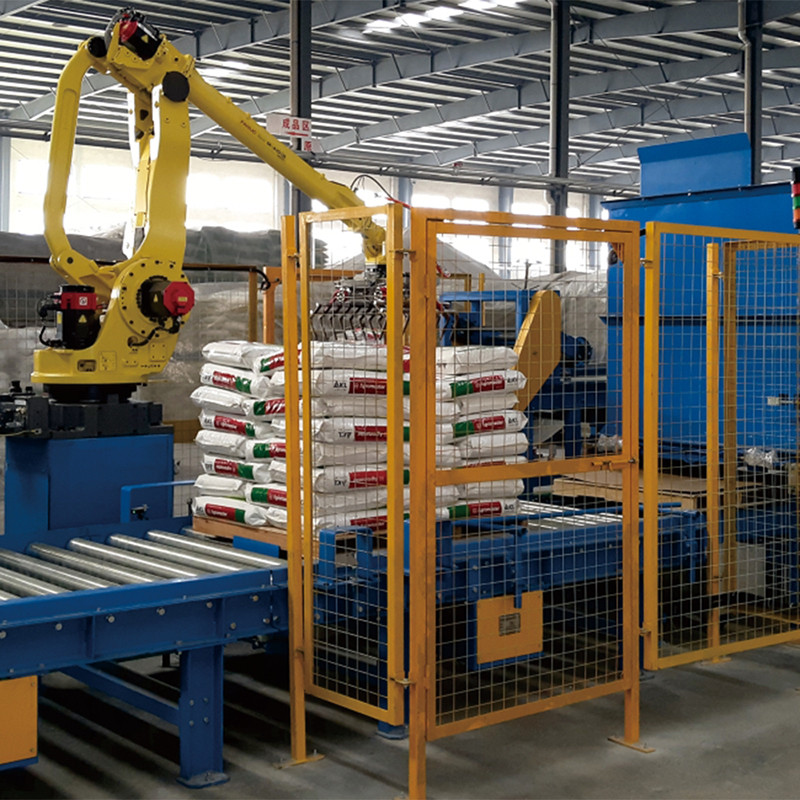
palletizing robot is a device specifically designed for automated stacking (neatly stacking goods on pallets, boxes, or other containers) and depalletizing (unstacking stacked goods). It can pick up goods from sources such as conveyor lines and shelves and place them accurately at designated positions according to a set trajectory — simply put, it is a mechanical arm that replaces manual labor for repetitive stacking.
Unlike traditional semi-automatic equipment, the core of a palletizing robot is intelligent automation: it does not require human monitoring, can automatically adapt to different types of goods, adjust stacking methods, and even operate efficiently in unmanned workshops late at night.
II. Core Features of Palletizing Robots: Solving 6 Pain Points of Traditional Stacking
Why are more and more enterprises choosing palletizing robots? The key lies in their technical design that precisely matches user needs:
1. Precise Stacking Without Toppling
Adopting a full servo drive system, each movement can be precise to the millimeter level. Whether it is cartons, plastic boxes, or bagged goods, the stacked goods will not be crooked, completely avoiding the risk of collapsing halfway.
2. Can Flex Its Muscles in Small Spaces
Lightweight design makes the body more compact, occupying more than 1/3 less space than traditional equipment. Even in narrow spaces such as warehouse corners and next to production lines, it can be easily installed without affecting the existing workflow.
3. Can Grasp Any Goods
Multi-axis drive design (commonly 4-axis or 6-axis) allows it to adapt to various types of goods: from lightweight food packaging to heavier auto parts, from square cartons to soft bagged goods, all can be stably grasped and accurately placed.
4. No Need to Relearn When Changing Products
Different stacking patterns (such as well shaped stacks, layered stacks) can be set through programming. When changing products, only the program needs to be adjusted, without retraining workers or replacing equipment — for example, stacking beverage cartons today and fertilizer bags tomorrow can be switched within half a day.
5. Fast Enough to Keep Up with the Production Line
It has a fast response speed, with picking, moving, and placing done in one go, able to keep up with the rhythm of high-speed production lines. For example, if a food factory's packaging line produces 1000 boxes per hour, the palletizing robot can complete stacking simultaneously, preventing goods from piling up at the door.
6. Safe and Reliable Without Troublemaking
The body is equipped with safety sensors and will immediately stop when encountering people or obstacles; it can also adapt to various working environments such as high and low temperatures and humidity, operating stably in both clean workshops of food factories and normal-temperature logistics warehouses.
III. Application Scenarios of Palletizing Robots: A Universal Tool Covering Multiple Industries
Palletizing robots are not niche equipment; their applications have penetrated into multiple industries requiring stacking:
1. Logistics Warehousing: Automatic Handling Even Late at Night
In e-commerce logistics centers and third-party warehouses, palletizing robots can automatically handle pallet stacking — for example, stacking sorted packages into standard pallets. Even for early-morning replenishment, there is no need to wake up workers, greatly improving warehouse turnover efficiency.
2. Food Processing: A Hygienic and Efficient Packaging Assistant
The food industry has high hygiene requirements. Palletizing robots can avoid manual contact with food packaging (such as biscuit boxes, beverage cartons), reducing the risk of bacterial contamination; at the same time, they can keep up with the production line speed, preventing packaged food from piling up on the ground waiting for manual handling.
3. Automobile Manufacturing: A Hauler for Heavy Goods
Auto parts (such as tires, instrument panels) are often heavy, and manual handling is prone to injury. Palletizing robots can easily grasp heavy goods and accurately stack them on shelves or conveyor lines, saving effort and ensuring safety.
4. Other Industries: A Universal Solution for Chemical, Pharmaceutical, and Electronics
Bagged fertilizers in the chemical industry, cartoned medicines in the pharmaceutical industry, component boxes in the electronics industry... As long as repetitive stacking is needed, palletizing robots can take over — no need to modify the equipment, just adjust the program to adapt.
IV. Core Advantages of Palletizing Robots: 4 Key Reasons for Enterprises to Choose Them
For enterprises, palletizing robots are not an additional expense but an investment for long-term cost reduction and efficiency improvement:
1. Doubled Efficiency: 24-Hour Non-Stop Operation
No need for rest or leave, operating around the clock, with efficiency far surpassing manual labor — for example, if manual workers can stack 100 pallets per day, a palletizing robot can do more, especially suitable for catching up with progress during order peaks.
2. Cost Reduction: Reducing Invisible Losses
On the one hand, replacing manual labor reduces recruitment and training costs; on the other hand, precise stacking avoids error losses such as goods collapsing and breaking — these hidden costs are often more worthy of attention than the equipment price.
3. Safer: Say Goodbye to Heavy Physical Labor
Manual stacking requires bending hundreds of times a day, which is prone to occupational diseases such as lumbar disc herniation. Palletizing robots can replace these heavy physical tasks, allowing workers to shift to more technical work (such as equipment debugging, quality inspection), improving employee satisfaction.
4. Flexible Adaptability: Adapting to Product Changes
When enterprises change products or modify packaging, there is no need to buy new equipment — just adjust the program of the palletizing robot to adapt to the new type of goods. For example, changing from stacking 10kg cartons to stacking 20kg bagged goods can be completed within half a day.
Conclusion: Palletizing Robots, the Standard Equipment for Future Enterprises
The value of palletizing robots lies in handing over repetitive, laborious, and error-prone work to machines, and leaving more valuable work to humans. From logistics warehousing to food manufacturing, they solve all the pain points of traditional stacking with their precision, efficiency, and safety features.
With the popularization of industrial automation, palletizing robots will not be an optional device but a must-have tool — whether you are a small warehouse or a large factory, as long as there is a stacking need, it can help you save effort and make more money.
For enterprises, choosing a palletizing robot is essentially choosing a smarter production method — replacing repetitive labor with machines and improving efficiency with intelligence. This is the core meaning of industrial automation.