Palletizing Robots: The Efficiency Engine Of Warehouse Logistics Automation, A Comprehensive Analysis From Features To Value
In the daily operations of manufacturing, logistics, and warehousing industries, stacking and handling goods are the most basic yet labor-intensive tasks. Manual palletizing is not only inefficient and error-prone but also carries risks of work-related injuries such as back injuries and crushing. With the popularization of automation technology, palletizing robots, as intelligent experts in stacking and handling, have gradually become the core tool for enterprises to solve the labor bottleneck and improve operational efficiency. What value can they create for enterprises? What irreplaceable advantages do they possess? This article comprehensively deciphers the efficiency code of palletizing robots from core features, application value to industry prospects.
I. What is a Palletizing Robot? The Automated Bridge Connecting Production and Warehousing
A
palletizing robot is an intelligent device that automatically completes goods stacking and handling tasks through programmed control of mechanical structures. It can accurately handle various goods such as cartons, packaging bags, and pallets, covering the entire process requirements from stacking at the end of the production line to warehouse goods sorting, equivalent to building an automated handling channel from workshop to warehouse for enterprises. Whether it is stacking beverage boxes in a food factory or sorting express parcels in an e-commerce warehouse, it can be an indefatigable porter.
II. 6 Core Advantages of Palletizing Robots, Solving Enterprises' Most Painful Stacking Problems
1. Diverse Types, Adapting to Full-Scenario Needs
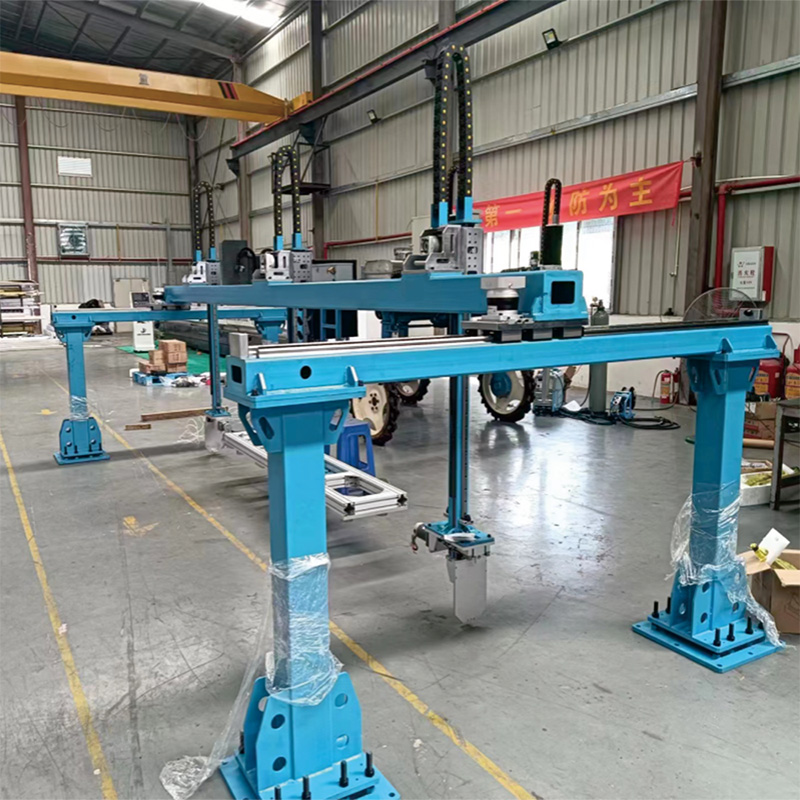
Palletizing robots are not universal equipment but are divided into cartesian coordinate, fully articulated, parallelogram, and linear horizontal multi-joint types according to their motion structures, each with a clear scenario positioning:
- Cartesian coordinate palletizers are suitable for regular space and high-repeatability production lines (such as mineral water production lines);
- Fully articulated robots have high flexibility and can handle special-shaped goods or complex stacking paths (such as irregular packaging of home appliance parts);
- Parallelogram structures focus on heavy load and high speed (such as heavy stacking of fertilizer bags and feed bags).
Enterprises can choose the most suitable type according to site size, goods type, and production capacity requirements, avoiding the waste of incompatibility between equipment and scenario.
2. High Precision + High Efficiency, Say Goodbye to Manual Shortcomings
Manual palletizing is prone to problems such as stacking (wāixié, askew) and uneven speed, while palletizing robots can ensure that each layer of goods is stacked neatly and with stable center of gravity through precise positioning systems and stable motion control, avoiding the risk of goods collapse due to unstable stacking. More importantly, it can run continuously 24 hours a day, with efficiency 3-5 times that of manual labor - for enterprises pursuing production capacity, this means the order processing capacity of handling hundreds of more pallets per day.
3. Flexibly Programmable, Coping with Multi-Variety Production
Modern enterprises often face production demands of multiple SKUs and small batches (such as food factories producing snacks, beverages, and frozen foods simultaneously), and frequent line changes can slow down efficiency. The programmability of palletizing robots just solves this pain point: by simply modifying the program or importing a new stacking scheme, it can quickly adapt to goods of different sizes and shapes (switching from cartons to plastic baskets, from bagged to boxed), without adjusting hardware, allowing enterprises to easily cope with the challenge of multi-variety production.
4. Safety Upgrade, Reducing Management Risks
When manually handling heavy goods, work-related accidents such as back injuries and crushing occur frequently, which not only increases the medical costs of enterprises but may also affect production rhythm. Palletizing robots can replace manual labor in hazardous environments (such as low-temperature cold storage, dust workshops) or heavy-load scenarios, and real-time monitor the surrounding environment through sensors to avoid collisions or misoperations, fundamentally reducing safety hazards - for enterprises that value safe production, this is an unquantifiable hidden value.
5. Long-Term Cost Optimization, More (kěguān, substantial) ROI
Although the initial purchase cost of palletizing robots is relatively high, in the long run, they can significantly reduce hidden costs:
- Replacing Manpower: 1 robot can replace 2-3 workers, directly saving monthly wages and social security expenditures;
- Reducing Losses: Avoiding goods damage caused by manual misoperation (such as carton deformation under pressure, packaging bag (huá pò, tearing));
- Lowering Maintenance: Modern palletizing robots have low failure rates, and maintenance costs are much lower than traditional equipment.
For enterprises focusing on cost control, this is a high-quality choice of one-time investment, long-term return.
6. Intelligent Upgrade, From Execution to Optimization
Modern palletizing robots are no longer mechanical executors - by equipping with sensors, vision systems, and data analysis modules, they can real-time track data such as speed, precision, and goods status during the stacking process and feed the information back to the enterprise's Manufacturing Execution System (MES). For example:
- When a batch of goods is stacked offset, the system will automatically adjust parameters;
- When production capacity fluctuates, the robot will optimize the motion path to match the rhythm.
This intelligent closed-loop upgrades palletizing from passive execution to active optimization, helping enterprises achieve digital upgrading of production processes.
III. Application Prospects of Palletizing Robots: From Single-Point Automation to Full-Link Collaboration
With the accelerating trend of intelligent manufacturing and warehouse logistics automation, the application boundaries of palletizing robots are constantly expanding:
- From traditional industries (food, beverage, medicine) to emerging fields (new energy battery module handling, e-commerce split-case palletizing);
- From single-point palletizing to full-link collaboration (linking with AGV automated guided vehicles and WMS warehouse management systems to achieve full automation from production to warehousing).
In the future, with the integration of AI vision and collaborative robot technology, palletizing robots will also realize collaborative work with humans - for example, in narrow warehouses, robots are responsible for heavy-load stacking, and humans are responsible for fine adjustments, further improving scenario adaptability.
IV. How to Choose a Palletizing Robot? Focusing on Scenario Matching is the Key
For enterprises wanting to introduce palletizing robots, choosing a supplier that fits their own scenario is the core:
- If special equipment for food and beverage lines is needed, EVS Robot can be focused on;
- If high-speed and precise stacking is emphasized, the PA series of Chaifu Industrial Robots is a good choice;
- If an integrated packaging + palletizing solution is needed, Krones' Robogrip series is worth referring to;
- If the flexibility of picking + palletizing is concerned, Swisslog's solutions are more suitable;
- If high-speed operation design is required, Comau's PAL series robots can meet the requirements.
Conclusion: Palletizing Robots, the Entry-Level Tool for Enterprises' Automation Transformation
From replacing manual labor to optimizing processes, the value of palletizing robots has long exceeded handling and stacking - it is the first piece of the puzzle for enterprises to realize automation transformation. Whether it is the manufacturing industry wanting to solve the difficulty in recruiting workers or the logistics industry wanting to improve warehouse turnover efficiency, palletizing robots can become the competitiveness engine of enterprises through the dual value of efficiency improvement + cost optimization.
In the era of automation, introducing palletizing robots one step earlier means seizing the efficiency advantage one step earlier - after all, for enterprises, every improvement in stacking efficiency is a direct increase in profits.