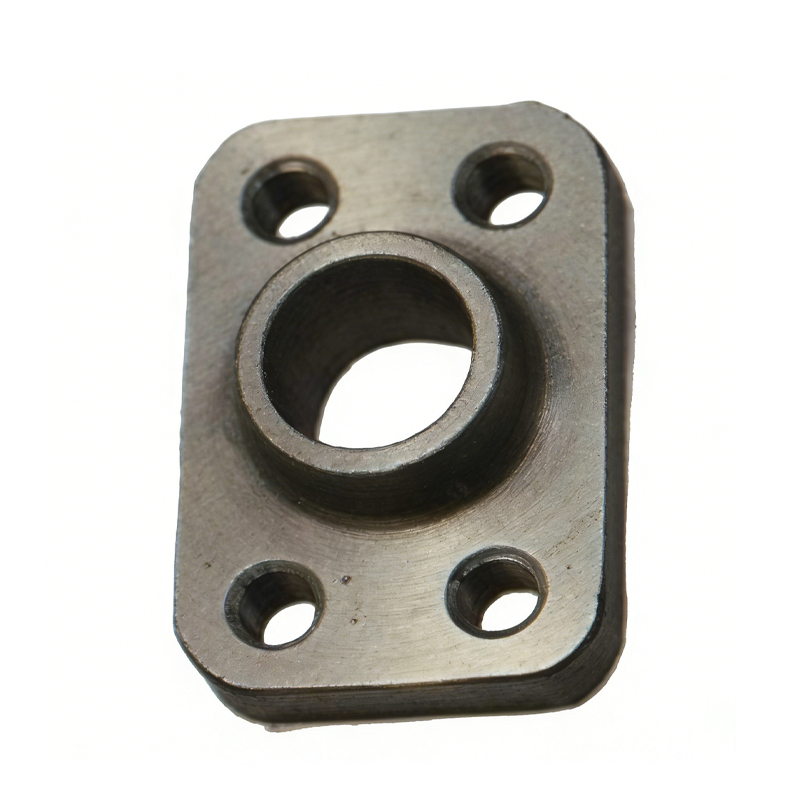
Mechanical processing is the core support of the manufacturing industry. From small screws in mobile phones to machine tool spindles in factories, almost all metal parts need to achieve precise shapes and dimensions through mechanical processing. Among the various mechanical processing methods, lathe machining has always played the role of a foundation layer - it is not only an important part of mechanical processing but also the first step in processing most complex parts.
I. What is Lathe Machining? - The Precision Shaping Art of Rotational Cutting
The core logic of lathe machining is simple: rotate the workpiece, use the linear or curved feed of the tool to gradually cut off excess metal, and finally obtain parts with features such as circular, cylindrical, or conical shapes. For example, the circular main bodies of bolt shafts, motor shafts, gear blanks, and even stainless steel spatula handles in the kitchen are all results of lathe machining.
Its essence is cutting based on rotation - the rotational movement of the workpiece provides a stable processing reference, and the feed of the tool controls the amount of material removal. This method determines the field where lathe machining excels: parts requiring circular cross-sections or rotational symmetry.
II. Why is Lathe Machining the Foundation of Mechanical Processing?
In the mechanical processing process, the role of
lathe machining is equivalent to setting the benchmark - the datum plane or datum axis of most parts needs to be ensured by lathe machining for precision.
For example, for the crankshaft of an automobile engine, the main journals at both ends (the core parts supporting the crankshaft rotation) must first be processed by a lathe. The roundness (whether the cross-section is a perfect circle) and coaxiality (whether the journals at both ends are in the same straight line) of these parts directly affect the vibration and service life of the engine during operation. If the precision of lathe machining is insufficient (e.g., roundness error exceeds 0.01 mm), even more precise grinding processes cannot compensate for the deviation in the basic dimensions later - just like if the foundation of a house is crooked, the upper floors will collapse no matter how neat they are.
III. The Irreplaceability of Lathe Machining: The Advantage of Rotational Precision
The unique value of lathe machining lies in its ability to achieve extremely high rotational precision. For parts requiring circular cross-sections (such as bearing inner rings and piston rods of hydraulic cylinders), lathe machining can control the roundness error within 0.005 mm - this precision is equivalent to 1/20 the diameter of a human hair.
This precision is difficult to replace by other processing methods. For example, although milling can process complex shapes, for circular parts, the point contact cutting of the milling cutter will cause roundness deviation; while the line contact cutting of the lathe (the tool continuously cuts along the rotating workpiece) can uniformly remove material and ensure a perfect circular cross-section.
IV. Process Collaboration Between Lathe Machining and Mechanical Processing
Lathe machining is never a solo operation but the first link in the mechanical processing. Its output is the datum part for subsequent processing:
- For example, for a gear, first, a lathe is used to process the gear blank (i.e., a circular metal disc) to ensure the coaxiality of its outer diameter and inner hole;
- Then, a milling machine is used to process the gear teeth;
- Finally, a grinder is used to grind the tooth surface to improve surface finish.
Without the datum blank from lathe machining, subsequent milling and grinding lose precise references - just like drawing an outline before painting, lathe machining is the step of drawing the outline for the part.
Conclusion: Lathe Machining is the Foundation of Mechanical Processing
From millimeter-sized small screws to meter-long machine tool spindles, from ordinary daily necessities to precision parts in aerospace, lathe machining has always been an indispensable basic link in mechanical processing. With the simple logic of rotation + cutting, it solves the core datum precision problem of mechanical parts - without lathe machining, there would be no subsequent precise mechanical processing, let alone every industrial product around us.
In short, mechanical processing is the skeleton of the manufacturing industry, and lathe machining is the marrow of the skeleton - seemingly ordinary, but supporting the operation of the entire system.